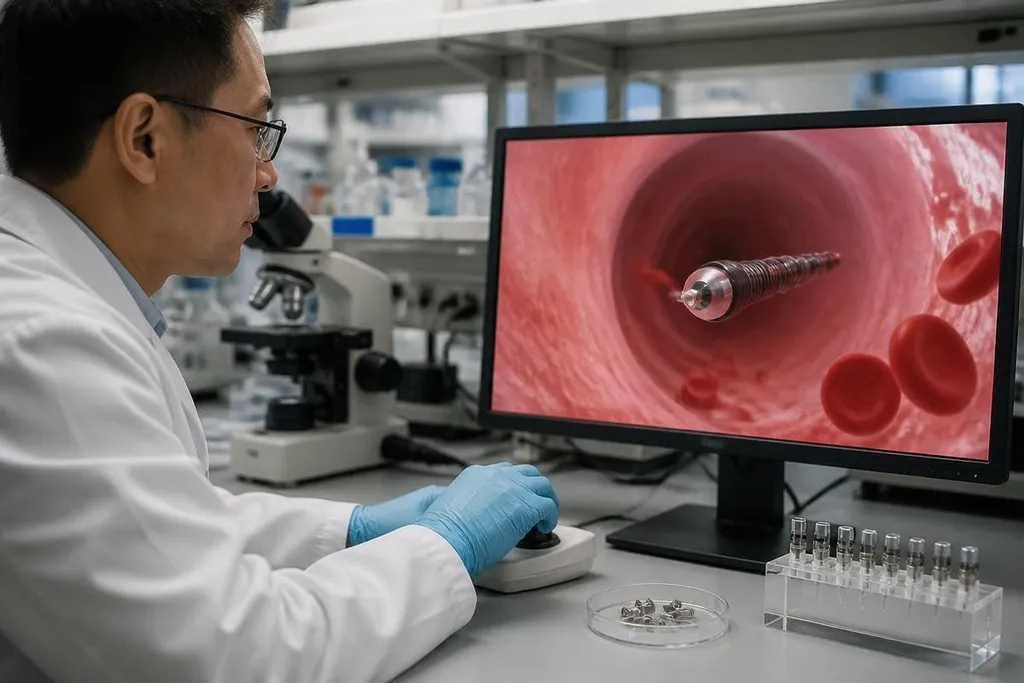
A medical robot small enough to move through blood vessels could reach places that surgical tools cannot. The hard part is keeping that robot on the right path, doing useful work, and leaving the body safely.
- Small robots could carry medicine to a chosen site.
- Magnetic fields, light, ultrasound, or chemical reactions can move some designs.
- Safe control and removal matter as much as movement.
What micro-robots could do
Micro-robots are small machines or engineered particles built to move through places that larger tools cannot reach. Some designs use tiny screws, flexible tails, capsules, or clusters of particles. Their shape affects how they move through fluid and tissue.
The medical use is more specific than “small robot enters the body.” A device might carry medicine, move a sensor, clear material from a narrow passage, or help with a biopsy. Each task needs a different body, power source, and control method.
A drug-carrying micro-robot could release medicine near a tumor or an area of infection. That could reduce exposure to healthy tissue, but the robot still needs to reach the right location and release the dose at the right time. Those are separate engineering problems.
How doctors could control them
A micro-robot cannot carry a normal battery, radio, and computer at the size people often imagine. Many designs therefore receive movement from outside the body. Magnetic fields can pull, rotate, or steer magnetic parts, while ultrasound can push or move other structures.
Imaging would guide the procedure. MRI, ultrasound, X-ray, or another imaging method could show where the robot is and whether it is moving as planned. The choice affects cost, visibility, radiation exposure, and how quickly a doctor can react.
Control becomes harder when blood flow, breathing, organ movement, and narrow vessels all affect the path. A robot that follows a route in still laboratory fluid may behave differently inside a moving body.
The useful test is not a clean demonstration; it is repeatable control under the conditions of care.
That gap makes source quality part of the medical test. Medical robotics reporting from Robot24.com can place a micro-robot’s design, control method, and test setting beside each claim before the section turns to safety.
The safety problems are larger than the robot
The small size creates risks that a normal surgical tool does not share. A broken part could be hard to find. A robot could stop in the wrong place, move into a vessel wall, or release its material too early.
The body also has to tolerate the device. Researchers must check the robot’s materials, coatings, movement, heating, and removal method. A design that works well in a dish may still cause inflammation or interact badly with blood.
Removal needs a clear plan. A doctor might retrieve the robot with a magnetic field, guide it out through a natural opening, or design it to dissolve after use. Each option creates another test: can the robot leave without damage, residue, or a second procedure?
The control system needs a safe failure state too. If imaging is lost or the external field changes, the robot should stop, return to a known position, or remain harmless until the doctor can act. “It moved” is a weak result if nobody can say what happens after a fault.
What has to happen before routine care
The path from a working prototype to a hospital procedure needs evidence at several levels. A practical review should ask:
- Task: Does the robot perform one defined medical job?
- Control: Can a doctor guide it when fluid and tissue are moving?
- Imaging: Can the team locate it throughout the procedure?
- Safety: What happens after a fault, break, or power loss?
- Removal: How does the robot leave the body?
- Proof: Has testing moved beyond simple lab conditions?
I’d wait for systems with a clear task and a clear recovery plan, even if a smaller robot looks more advanced on paper.
The useful promise
Micro-robots may give doctors new ways to reach narrow or difficult parts of the body. Their value will come from controlled treatment, not from being tiny by itself.
The first systems to matter will probably do one job, in one location, with imaging and removal built into the procedure. The open question is whether that narrow task can be made safe enough for routine care.